Context & State Management
Keep useful project signal in context without making the provider cache—or one fixed compression ratio—the continuity boundary. Supported routes can combine output shaping, stable prefixes, digest envelopes, inline diagnostics, and local context pages.
The Context Lifecycle Loop
A supported ostk-managed turn can combine the following stages. Provider caching, output shaping, enrichment, and drain behavior remain route-specific rather than universal.
PRELOAD_RENDER TOOL_CALL OUTPUT_COMPRESSION DIGEST_INJECTION 304_ELISION DRAIN_SNAPSHOT Prompt Caching & Fleet Economics
Prompt caching and output compression can reduce repeated input on routes that support them. The result depends on provider pricing, cache eligibility and lifetime, message stability, model behavior, and harness integration. Needle Bench reports model-and-harness outcomes separately; use a measured combination instead of a blanket savings claim.
Supported provider routes can reuse an identical stable prompt prefix. Volatile project and turn data belongs after the cacheable boundary.
Cache writes, reads, token accounting, and prices vary across providers, models, API versions, and configured gateways.
Cache lifetime and refresh behavior are provider-controlled. A warm prefix is an optimization, not part of ostk's continuity contract.
On compatible routes, ostk positions cache-control boundaries around stable system, preload, tool-definition, and message-history regions. Unsupported routes continue without this provider-side optimization.
Output Compression (The Squasher)
Kernel-mediated command output is routed by category, matched to a command grammar or output shape, and reduced only after hazards and outcomes are identified. Elisions remain visible and telemetry records the actual result.
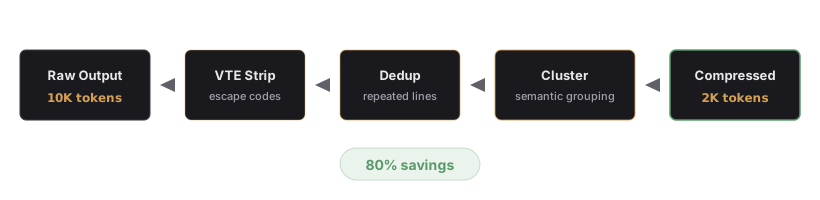
Signal Before Reduction
Command grammars and output-shape detectors identify hazards, outcomes, and structured diagnostic blocks before deduplication. Unknown shapes fall back conservatively, tiny inputs avoid the full grammar path, and raw: true bypasses compression when exact output matters.
Condense Signal Classification
Lines are evaluated against rules and grouped into:
- HAZARD (High Priority): Deprecations, lock timeouts, and warnings. Always preserved.
- OUTCOME (Medium Priority): Build metrics, test counts, and exit states. Preserved verbatim.
- NOISE (Low Priority): Iterative logs, progress bars, and dividers. Subject to immediate Levenshtein collapsing.
Consecutive Structural Deduplication
Consecutive lines that begin with the same first token are compared using normalized edit distance. The current implicit path collapses a run when distance is below 0.4 (roughly similarity above 0.6), generalizing dynamic tokens with tags such as {hash}, {path}, and {ver}. Every collapsed run stays visible as [⋯ N similar lines].
ROUTE_CATEGORIES
Semantic Deduplication via Potion-Base
Optional semantic clustering can identify lines that mean the same thing even when their structure differs. Its current similarity threshold is 0.85; this is separate from the lower-threshold consecutive structural deduplication above. Install the optional local model with ostk embeddings download.
--features embeddings. DEDUP_PATTERN
Digest Envelopes & Read Prevention
To prevent agents from repeatedly reading files to check for external updates, the kernel appends a 5-line status envelope to every tool response.
Layer 1: Digest Suppression
If files haven't changed, they are omitted from the [files] block. Seeing no stale entries, the agent has no reason to issue a read command, avoiding the lookup entirely.
Layer 2: 304 Elision
If the agent attempts to read a file anyway, the kernel queries the generation table. If no writes have occurred since the agent's last read, the kernel overrides the read and returns [304] path:gen=N (current).
Driver Enrichment Hooks & Diagnostics
Registered FCP drivers (such as fcp-rust wrapping LSP) intercept file operations to inject compilation diagnostics, outline symbols, and manage type-safe multi-file refactoring.
Inline Diagnostic Injection
Diagnostics are injected directly as virtual code comments inside the file read response. The agent receives compiler errors inline with the source code, eliminating the need to compile manually to find syntax errors.
fn main() {
    let x = 5;  // [error] unused variable `x` (E0001)
    println!("hello");
}
PROGRESSIVE_DISCLOSURE
Type-Safe Refactoring via LSP
Drivers expose symbol graphs to support complex, multi-file refactoring verbs. When executing refactorings, the driver computes all edits, and the kernel processes them atomically under OCC CAS rules.
Updates symbol and all references across the codebase safely. Prevents regex search errors.
Selects code, extracts it, and computes parameters and return structures.
Inlines function or variables, validating that visibility and scopes are preserved.
EMBEDDINGS_VS_DRIVERS
| Signal | Embeddings (Breadth) | Drivers (Precision) |
|---|---|---|
| Related function | ~0.75 cosine similarity | Exact call graph mapping |
| Relevant file | Shared vocabulary/topics | Direct import dependency |
| Dead code detection | Cannot determine | Zero reference symbols |
| Call chain path | Co-occurrence heuristics | Exact static call-stack traversal |
| Test coverage scope | Cannot determine | Test target reference mapping |
SAFETY_AND_TIMEOUTS
Capabilities & the SKILL Directive
The SKILL directive declares named capability bundles within an Agentfile. The parser extracts these into a simple vector, which is resolved at spawn time.
Format: SKILL <bundle_name>. Multiple declarations compile into Agentfile.skills: Vec<String>. Missing skill arguments trigger a ParseError::MissingArgument error.
At spawn time, the harness maps these identifiers to skill packages (e.g. resolving skills/<name>/SKILL.md) to append system prompt instructions, configure required tools, and establish style conventions.
FROM claude-sonnet-4-6
PROMPT You fix bugs and write tests.
SKILL tdd
SKILL commit
TOOL shell
TOOL file:edit
Task Eligibility & the WORK Directive
Rather than a push-based routing engine, ostk implements a pull-based task architecture. Agents declare task eligibility using affinity masks defined via the WORK directive.
Format: WORK <expr> [<expr>...]. Multiple expressions on a single line are space-separated (evaluated as logical AND). An Agentfile can contain at most one WORK directive.
- Parsed into
WorkFiltercontaining a list of match expressions. - If omitted, the agent defaults to
work: None, indicating it is eligible to pull any task. - Declaring multiple
WORKdirectives triggers aParseError::MultipleWorkerror.
EXPRESSION_OPERATORS
= priority=P0 Exact match constraint. >= priority>=P1 Lower bound mapping (P0 < P1 < P2 < P3). <= priority<=P2 Upper bound mapping. =a,b tags=rust,bugfix Comma-separated list (matches if the task has ANY listed tag). FROM claude-sonnet-4-6 WORK tags=rust,bugfix priority>=P1 TOOL shell TOOL file:edit
Context Pressure & Successor Handoff
To preserve prompt caching, the kernel avoids in-turn context compaction. Instead, when context thresholds are crossed, the agent initiates a clean, structured handoff to a fresh successor process.
70% Threshold (AGING)
The kernel signals AGING state. Pre-computations begin to compile the handoff registry, while the current task loop runs unhindered.
90% Threshold (DYING)
State advances to DYING. Future tool calls are blocked. Handoff payloads are finalized. Sudden token jumps bypass AGING directly here.
Handoff (DRAINING/DEAD)
A single finalization turn (DRAINING) commits the handoff to disk, transitioning the session to DEAD. A fresh successor rehydrates the handoff state.